
Allow Returns.
That Is the Whole Article.

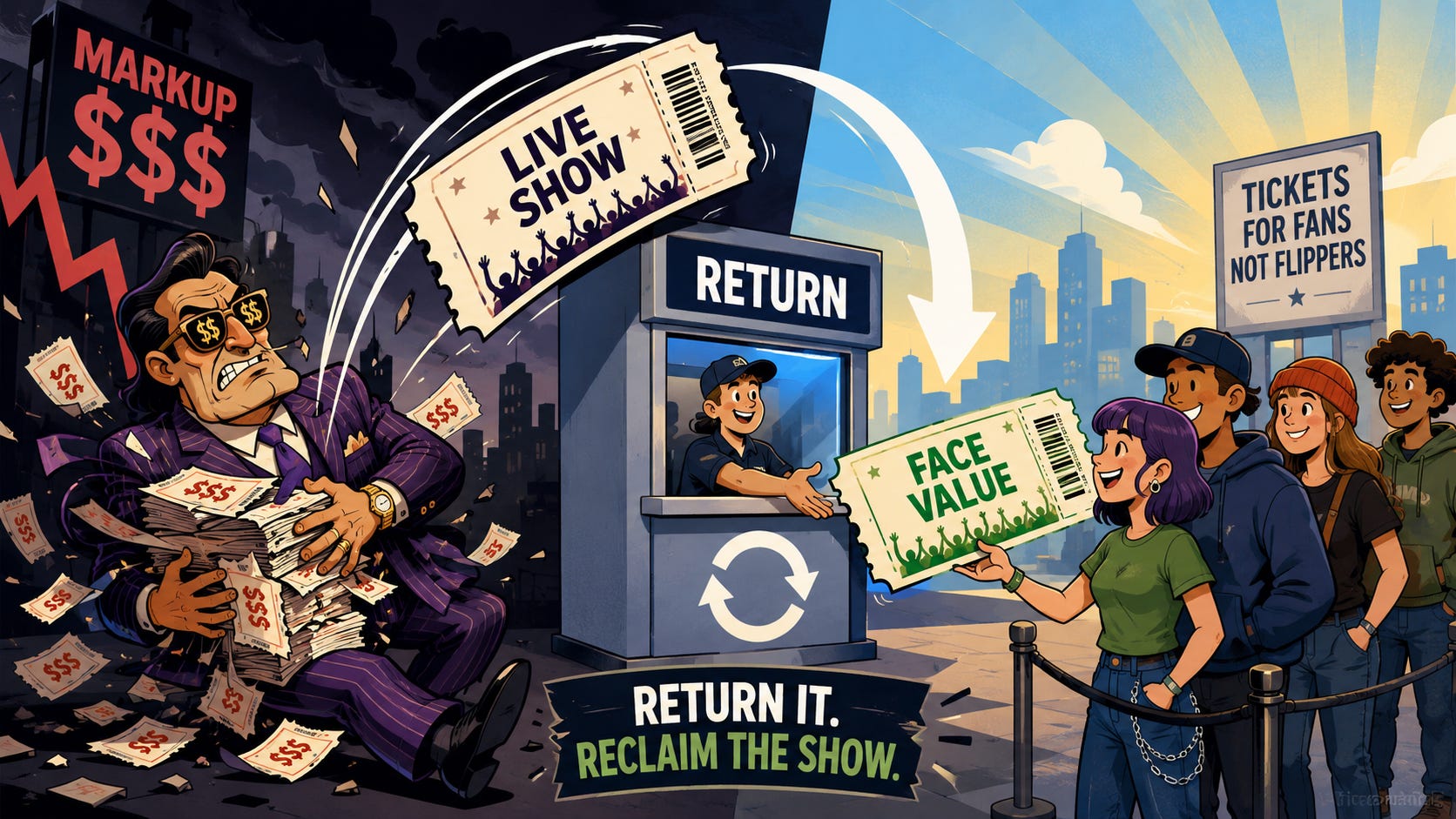
There’s a simple way to stop ticket scalpers. I’m going to tell you what it is. But first, I’m going to walk you through some things, because if I just lead with the answer, you won’t believe me, and then I will have to explain it anyway, and I’d rather do it once.
Scalping is not complicated.
A scalper buys tickets he doesn’t want so that you can’t have them, and then he sells them back to you at whatever price your desperation will support. That’s the entire business model. There’s no craft to it. There’s no skill. A guy with a credit card and a bot did something any idiot could do, and now he’s going to charge you four hundred dollars over face value to see a band you have liked since you were seventeen. He didn’t earn that money. He extracted it from you because he got there first and the rules let him.
I want to be clear about something before we go further. The scalper isn’t the villain of this story. He’s doing something legal. He’s doing something the system was built to allow him to do. You don’t have to like him, but he’s a symptom. The people who designed the system and keep it running exactly as it is, those are the people we’re going to talk about.
Everyone who says they want to stop scalping is lying to you.
Ticketmaster says it wants to stop scalping. Ticketmaster also owns the dominant verified resale platform and takes a cut of every secondary transaction that runs through it. Live Nation says it wants to stop scalping. Live Nation also profits enormously from the premium resale market that scalping creates and inflates. They are the same company and just lost an antitrust monopoly case by the way.
The venues say they want to stop scalping. The venues also sell platinum tickets at market rate, which is just institutional scalping with a cleaner website and a better excuse.
These aren’t organizations that want to solve the problem. These are organizations that have correctly identified the problem as a revenue stream and have spent considerable money making sure you believe they’re working on it. The blockchain ticket solution, the non-transferable NFT ticket, the dynamic pricing model, and the verified fan presale, all of it is performance. Some of it is well-intentioned performance by people inside those organizations who genuinely hate scalping. Most of it is theater designed to make you feel like progress is happening while the machine keeps running exactly as designed.
I’m not saying this to be cynical. I’m saying it because it’s true, and it’s the only useful frame for understanding why a solvable problem hasn’t been solved.
When someone wants to look smart about ticket scalping, they propose one of about six things. I’ll go through them quickly because they all have the same problem, and I want to get to the actual solution before either of us dies.
Non-transferable tickets. You tie the ticket to your ID, you show up, you prove you’re you, scalpers can’t transfer what they buy. This sounds good until you realize it requires massive venue infrastructure, constant enforcement, and would destroy the legitimate secondary market for people who genuinely can’t attend anymore. Also, the platforms that would implement it profit from the resale market they would be destroying, so they’re not going to do it. The Foo Fighters and other bands actually do this for small shows, by the way.
Face value only resale exchanges. You can resell, but only through the official platform and only at face value. Same problem. The official platform makes significantly more money on uncapped resale. They won’t do this voluntarily, and there’s no law making them.
Lottery systems. Instead of first come first served, you enter a lottery and tickets are distributed randomly at face value. This is actually pretty reasonable. It doesn’t stop scalpers from entering the lottery though, and it doesn’t solve the fundamental issue that once someone has a ticket they can do whatever they want with it.
In-person only sales. You have to show up physically to buy a ticket. This is nostalgic and completely insane.
Do not announce the sale time. Surprise drop so scalpers can’t prep their bots. Scalpers have people watching for this specifically. This lasts about forty-eight hours before it stops working.
All of these solutions are trying to solve the problem at the point of sale. Get the right people the tickets in the first place, and you have won. That’s a reasonable instinct. It’s also where every smart person has been putting their energy for twenty years, and scalping is still happening, so I’m going to suggest we look somewhere else.
Scalping requires two things to work. It requires the scalper to be able to buy tickets, and it requires the tickets to stay valuable once he has them.
Everyone focuses on the first part. Stop the scalper from buying the tickets. Bots, lotteries, ID verification, all of it is trying to solve part one.
Nobody talks about part two.
If the tickets don’t stay valuable, the scalper doesn’t have a business. He has a pile of tickets he can’t sell at a profit. Which means he either sells them at face value or he eats the loss. The end.
So here is the solution.
Allow returns.
That’s it. That’s the whole article.
You allow returns. Ticketmaster or whoever relists the ticket at face value. They keep the processing fee because they did process it. The seat gets filled. The artist gets paid. The fan gets a ticket at a normal price. The scalper has no leverage.
I know you want me to keep going so I will, but I need you to actually sit with that for a second. The entire solution is just a standard consumer protection that applies to literally every other product you can buy. You can return shoes. You can return a blender. You can return a couch. You can’t return a concert ticket, and that one carveout from basic consumer norms is what the entire scalper economy is built on. That’s not an accident. That’s a choice.
Let’s start with the regular person. Right now, when you buy tickets, you buy them in a panic because you know they will be gone in minutes, and if you don’t act immediately, you won’t get them at all. So you overbuy. You buy four when you need two because you’re not sure your friends are actually coming. You buy for a show three months out when you have no idea what your life looks like in three months. You do all of this because the ticket is a one way door. Once you’re through it, the only way out is the secondary market, which means becoming a small-time scalper yourself just to recoup your money when your plans change.
With returns, you don’t have to do any of that. Buy the tickets. If your friend bails, return one. If the show conflicts with something in September, return them. Get your money back minus a reasonable processing fee. Normal consumer behavior. Normal consumer expectations.
Now let’s talk about the scalper. He buys six hundred tickets to a major show because he knows the demand is there and none of them are coming back. That’s the bet. With no returns, it’s a pretty safe bet. The worst case is he sells them all at face value and breaks even. The realistic case is he sells most of them at two to five times face value and funds his cocaine and boat payments for the quarter.
With returns, the bet gets a lot shakier. Because now the buyers know they can return. Which means the buyers aren’t panicking the same way. Which means some of them are going to wait and see if tickets reappear in the official pool at face value before they pay his markup. And some of them are going to pay the markup as insurance, get home, see that face value tickets have popped back up, return his ticket, and buy the cheaper one. He can’t stop this. He sold the ticket. The buyer owns it. The buyer can return it if the platform allows returns.
So now he’s sitting on six hundred tickets and the demand he was counting on is softer than he expected, because the panic he was feeding off of isn’t as acute when people have an escape hatch. He has to decide: sell closer to face value, return them himself, or hold and hope. If he returns them, the tickets go back into the pool, and fans get them at face value. If he holds on and the show is next week and he still has four hundred tickets, he’s going to be selling at or below face value just to move them. Either way, the premium that was funding his lifestyle is gone.
And here is the part that I find genuinely elegant. You don’t need to catch the scalper. You don’t need to prove he’s a scalper. You don’t need a law, an investigator, or a special task force. You just need a return policy. The market does the rest on its own.
Someone is going to say that artists and venues would lose money if people could return tickets, because some sales that are currently locked in would get refunded.
I’d like you to think carefully about which concerts have scalping problems. It’s not the shows that are struggling to sell. Scalping happens at shows where demand dramatically outpaces supply. Beyonce. Taylor Swift. The Rolling Stones on what is apparently a never-ending farewell tour. A rapper who hasn’t put out an album in three years but has decided this is a good time to do an arena run. These aren’t shows worried about empty seats.
If someone returns a ticket to a show like that, Ticketmaster relists it, and it sells again, probably within minutes, because there are ten thousand people on a waitlist who couldn’t get tickets in the first place. The seat doesn’t go empty. The artist doesn’t lose money. Ticketmaster might actually make more money because they collect the processing fee twice, once on the original sale and once on the relist.
The argument that returns would hurt revenue only applies to shows where demand is soft, and those shows don’t have scalping problems. So the objection is answering a question nobody asked.
The problem is that the people who could implement returns profit from the current system.
Ticketmaster’s resale platform charges fees that make the original service charges look modest. The entire platinum ticket and market pricing system is just Ticketmaster doing institutionally what the scalper does individually, buying low and selling high on the backs of demand they didn’t create. If you implement returns at face value and relist inventory through official channels, you’re directly competing with your own premium resale product. You’re taking revenue that was going to be large and making it small.
It’s not that nobody has thought of this. It’s that the people who run this industry looked at it, understood it completely, and said, no thank you. They prefer the version where they make more money. Then they hired a communications team to make sure you stay focused on the scalper standing outside the venue with a fistful of tickets, rather than the corporation that built the system he’s standing inside of.
That’s the whole story. Everything else is details.
The scalper isn’t a criminal mastermind. He’s a guy who noticed that tickets are non-refundable, and that panicked buyers will pay a premium to avoid missing something they care about. That’s a reasonable observation. He’s exploiting a policy choice that the platforms made, not some fundamental law of nature.
The platforms aren’t trying to solve the problem. They’re managing public relations around a problem they have decided is more profitable to maintain than to fix.
The solution is a return policy. A normal, boring, standard return policy that would be completely unremarkable if it applied to literally any other product you can buy. You return the ticket. They relist it. The scalper’s inventory becomes worthless as a speculation vehicle. Prices compress toward face value because buyers don’t have to panic buy anymore.
Nobody in a position of power is going to do this without being forced to, because it would cost them money. That’s the part that’s exhausting. Not that the problem is hard. That the problem is easy, and the people who could fix it have looked at it carefully and decided they would rather not.
You’re welcome.
P.S.
Scalpers are subhuman and should be in jail. Not a nice jail. One of those jails in Nicaragua where the walls are damp, and nobody comes to check on you.
And while we’re here, every financial parasite who has built a career around withholding something people need until the desperation is high enough to monetize deserves a cell right next to them. The guys who run pharmacy benefit managers. The guys who run platforms. The middlemen who insert themselves between a human being and a thing that human being wants, and have decided that their presence in that gap entitles them to a cut. They didn’t make anything. They didn’t improve anything. They just got there first and held it hostage.
You know what else operates that way. A virus. A virus finds something your body needs, occupies it, and extracts resources from the host until there’s nothing left. It doesn’t produce value. It intercepts it. It doesn’t have a skill. It has a position, and it will defend that position with everything it has because without it, it’s nothing.
I’m not saying scalpers are literally viruses. I’m saying the mentality is identical, and I think that’s worth sitting with.
Sorry, I think I'm missing something. If all tickets are, practically, only available from scalpers for 17 times list, and you can only return them for list, and scalpers will immediately grab returned tickets so show-goers can only buy from scalpers ...
"And some of them are going to pay the markup as insurance, get home, see that face value tickets have popped back up, return his ticket, and buy the cheaper one."
Why would you do this? I suppose if the face value ticket on the original site is a better seat it would be worth it, but otherwise... you've already paid over list for a ticket, why buy another one at list and return that scalper ticket to the original site for list?
I don't agree with you about much, but this sounds like it would work. And it won't happen without a state intervention since you're correct about the profits involved. The original complaint about scalpers was purely that someone other than the official seller was making money from it, and now they're making most of that money.